



When choosing an embossed rolling pin, the things that decide whether it works are engraving depth, the wood it is cut from, whether the surface is left untreated, and the length of the engraved section. Pattern and price are the easy part. Depth is what separates a pin that prints a cookie from one that leaves a faint mark.
This guide sets out what to look for, what the trade-offs actually are, and how to read a product listing that does not tell you what you need to know.
1. Engraving depth
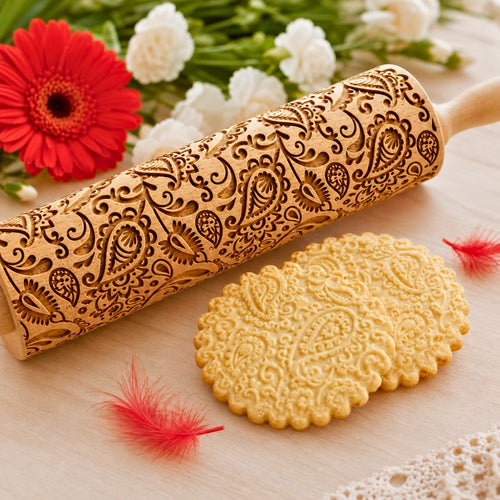
A shallow pattern marks the dough. A deep one displaces it. In the oven the cookie always loses a little relief as it warms and settles - so the question is how much height it had to start with.
Depth is hard to judge from a listing, because the standard product photo is taken looking straight down at the pin, which is the one angle that hides it. What to look for instead:
- A photo of the pin from the side or at an angle, where you can see into the grooves.
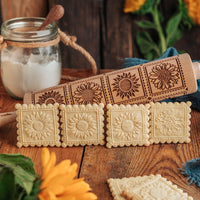
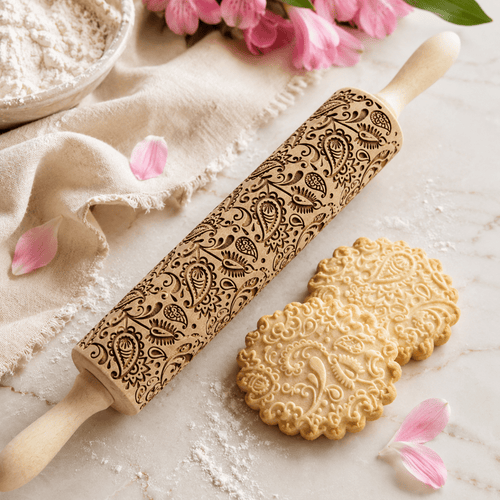
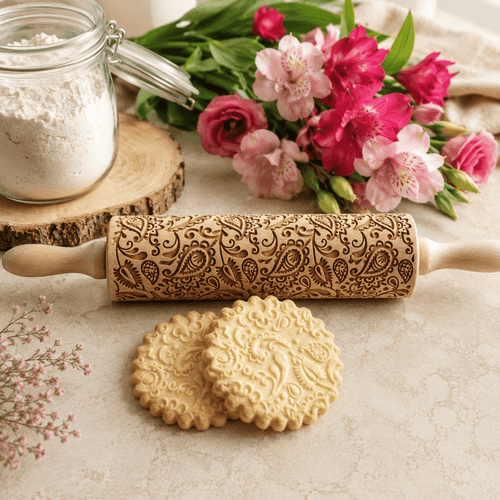
- A photo of the finished baked cookie, not just the raw dough. Raw dough always looks impressive. The oven is the test.
- Whether the seller shows the pattern on a plain shortbread rather than on fondant. Fondant takes a crisp impression from almost anything.
If a listing only ever shows dough and never shows a baked result, that is worth noticing.
2. Material
| Material | How it behaves |
|---|---|
| Beech, maple and other close-grained hardwoods | Hard enough to hold fine detail without the edges of the engraving crumbling. Neutral in smell and taste. The traditional choice for food tools. |
| Softwoods (pine, poplar) | Cheaper and lighter. The engraving edges soften with use and the wood dents easily. |
| 3D-printed plastic or resin | Allows very intricate patterns at low cost. Printed layer lines can trap dough, and the surface is usually lighter, so you supply all the pressure yourself. Check that the material is food-contact rated. |
| Silicone or embossing mats | A different tool. Flexible, easy to clean, but presses rather than rolls, and gives a shallower impression. |
Weight is part of this. A heavier pin does some of the pressing for you; a very light one means the pattern depends entirely on how hard you lean.
3. Untreated or coated
Varnish and lacquer make a pin look glossy in a photograph, but the coating settles into the bottom of the engraving - the exact place depth matters. It also wears unevenly, and once it starts flaking it is on your dough.
An untreated hardwood pin looks plainer and performs better. It needs slightly more care in return: no soaking, no dishwasher. See cleaning and care.
4. Size
What matters is the length of the engraved section, not the overall length. A long pin with a short pattern still only prints a short band of dough per pass.
| Size | Overall | Engraved section | Weight | Suits |
|---|---|---|---|---|
| Kids | 235 mm (9.2″) | Short | Light | Children rolling on their own |
| Regular | 380 mm (15″) | 200 mm (7.9″) | 400 g | Most home baking |
| Big | 460 mm (18″) | 250 mm (9.8″) | 600 g | Large batches, big fondant sheets, fewer passes |
5. Pattern: repeating or one-off
Most engraved pins carry a repeating pattern that tiles as you roll - florals, geometrics, textures. These are the versatile ones: you roll a whole sheet, then cut whatever shape you like out of it.
Some pins carry discrete motifs spaced around the barrel. Those look striking but need the cutter to be lined up with each motif, which is slower and less forgiving.
If you want more than one design without buying more than one pin, a 6-in-1 cookie stamp cube gives you six patterns on the six faces of a single block - though it presses one cookie at a time rather than patterning a whole sheet.
6. Who made it
Engraved rolling pins are widely drop-shipped, and the same generic pin appears under many names. It is worth knowing whether the seller manufactures or resells, because it determines whether anyone can answer a question about the engraving, replace a faulty pin, or cut a pattern to order.
Pastrymade cuts and finishes every pin in its own workshop in Łomianki, Poland, and has done since 2018. That is also why custom engraving is possible at all: send vector artwork to contact@pastrymade.com with a minimum order of five pins and we cut it. See custom design.
7. What happens if it is not right
Check the returns window before you buy, and check whether it covers a tool that has been used once. A pin that has rolled a single sheet of dough is no longer factory-fresh, and a policy that only accepts unopened goods is not much use for a tool you cannot evaluate without trying it.
Our own terms: a 60-day money-back guarantee from delivery on every item, plus the 14-day statutory right of withdrawal for consumers in the EU, EEA and UK, which exists independently of it. Return shipping is at the customer's cost, to the workshop in Poland. Full terms in the refund policy.
Quick checklist
- Is there a photo of a baked cookie, not just dough?
- Is the pin hardwood, and is it left untreated?
- How long is the engraved section?
- Does the pattern repeat, so you can cut any shape from the sheet?
- Does the seller make it, or resell it?
- Does the returns window cover a pin that has actually been used?
Related guides
What an embossed rolling pin is and how it works · How to use one · The right dough · Cleaning and care
Browse: embossed rolling pins · cookie stamp cubes · kids' pins · best sellers
Leave a comment
Tried this at home? Tell us how your cookies turned out.