



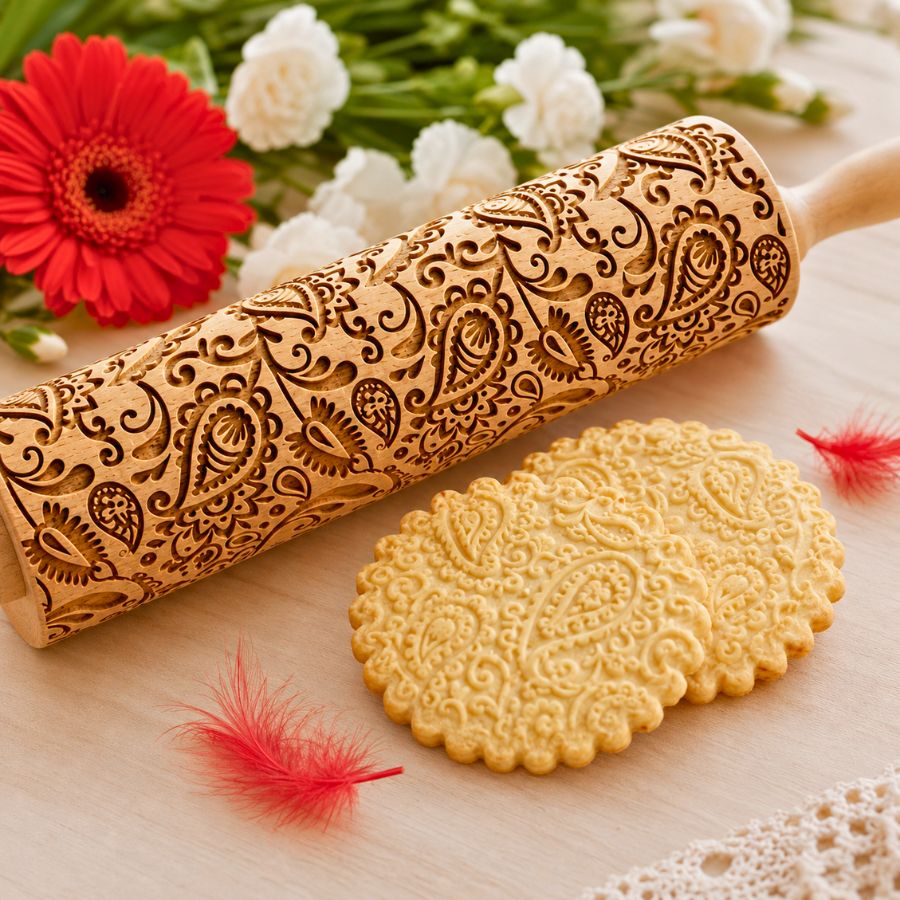
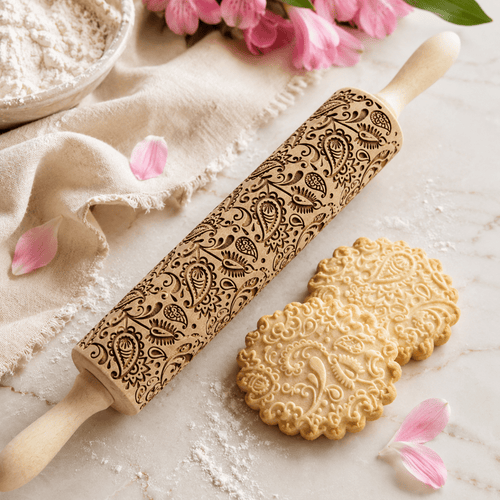
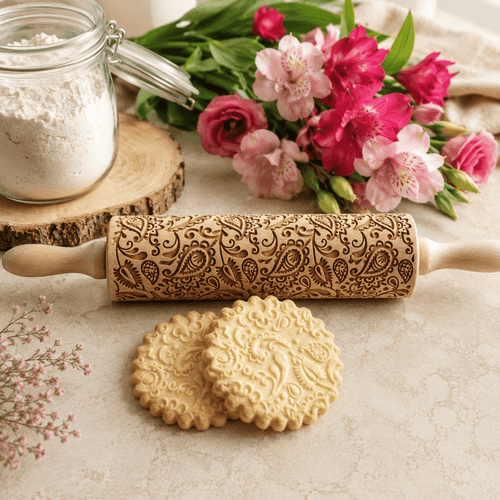
An embossed rolling pin is a rolling pin with a pattern cut into its surface. You roll it once over flat, chilled dough and the whole design is pressed in at the same time. The relief stays through baking, so the cookie comes out decorated without any icing, piping or stencilling.
They are also sold as engraved rolling pins, patterned rolling pins or cookie rolling pins. All four names describe the same tool. This guide covers how they work, what they can and cannot do, what sizes exist, and how they compare with cookie stamps and cutters.
How an embossed rolling pin works
The pattern is carved into the wood rather than printed on top of it. When you roll the pin over dough, the raised parts of the wood push into the dough and the hollows let the dough rise up. What you get is a relief: a raised design standing above the surface of the cookie.
Two things decide whether that relief survives the oven.
Engraving depth. A shallow pattern only marks the surface. As soon as the dough warms up and spreads slightly, the marks close. A deep cut pushes dough far enough out of the way that there is real height to lose before the design disappears. This is the single biggest difference between pins that work and pins that disappoint, and it is not visible in a product photo taken from directly above.
Dough behaviour. A dough that spreads erases its own pattern. Doughs with no chemical leavening and a high proportion of butter to sugar hold a print best - shortbread first, then a plain sugar cookie made without baking powder. We cover this in detail in the guide to dough for embossed cookies.
What you can emboss
- Shortbread and sugar cookie dough - the two doughs the tool is designed around.
- Gingerbread and speculaas - work well when the recipe leaves out the raising agent.
- Fondant and sugar paste - take a very crisp impression and hold it indefinitely, which is why cake decorators use these pins.
- Pie crust and pastry lids - embossing the top crust before baking gives a decorated pie with no lattice work.
- Fresh pasta - a textured sheet holds sauce better; the pattern is decorative rather than sharp.
- Salt dough and air-dry clay - not food, but the same tool, and a common use for people making ornaments and pottery.
What does not work: anything that rises. Bread dough, choux, cake batter and any cookie recipe built on baking powder or baking soda will puff up and flatten the design.
Sizes
Pastrymade pins come in three sizes. The number that matters is the operating part - the length of the engraved section - because that sets how much dough you can pattern in a single pass.
| Size | Overall length | Engraved section | Weight |
|---|---|---|---|
| Kids | 235 mm (9.2″) | Shorter, sized for a child's hands | Light |
| Regular | 380 mm (15″) | 200 mm (7.9″) | 400 g (14.1 oz) |
| Big | 460 mm (18″) | 250 mm (9.8″) | 600 g (21.2 oz) |
Regular suits most home baking. Big is worth it if you bake in quantity, work with large fondant sheets, or want fewer passes across a rolled-out sheet. The kids' pin is a genuinely smaller tool, not a regular pin with a different label - a child can hold it and press down evenly without help.
Embossed rolling pin, cookie stamp or cookie cutter?
They solve different problems and many bakers own more than one.
| Embossed rolling pin | Cookie stamp cube | Cookie cutter | |
|---|---|---|---|
| What it does | Prints a continuous pattern across a whole sheet of dough | Presses one design at a time | Cuts an outline, adds no pattern |
| Designs per tool | One repeating pattern | Six, one per face | One shape |
| Best for | Batches, all-over patterns, fondant, pie crust | Variety, small batches, baking with children | Shaping cookies, used alongside either of the above |
| Then what | Cut into shapes with a cutter | Usually cuts its own edge | - |
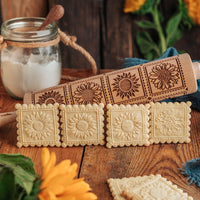
The usual workflow is a pin plus a set of round or square cutters: roll the pattern across the whole sheet, then cut individual cookies out of it. The buying guide goes through this choice in more detail.
What an embossed rolling pin is made of
Pastrymade pins are cut from beech, a dense hardwood, and left untreated. Beech is the traditional choice for kitchen tools that touch food: it is hard enough to hold a fine engraving without the edges crumbling, and it has no strong smell or taste to pass on to dough.
Untreated means no varnish and no lacquer. A sealed pin looks glossy in photographs but the coating fills the bottom of the engraving, which is exactly where you need depth. It also wears off unevenly with use.
Every pin is engraved and finished in our own workshop in Łomianki, Poland. We have been making them since 2018, and we make what we sell rather than reselling stock from elsewhere.
Common questions
Do embossed rolling pins actually work?
Yes, on the right dough. The two failures people report are almost always the same: a pattern cut too shallow to survive spreading, or a dough that rises. Use a chilled, unleavened dough and a deeply engraved pin and the design comes out of the oven intact.
Why does my pattern disappear when the cookies bake?
The dough spread. That happens when the dough was too warm going into the oven, when the recipe contains baking powder or baking soda, or when there is too much sugar relative to butter. Chill the cut shapes until firm and use a recipe with no raising agent.
Can you wash an embossed rolling pin?
Not in water, and never in a dishwasher. Wood swells and cracks. Brush the flour out of the grooves with a dry brush and wipe the surface with a barely damp cloth if you need to. Full cleaning guide here.
How thick should the dough be?
Between 5 and 7 mm. Thinner than that and the engraving reaches the work surface before the pattern is fully formed. Thicker and the cookie bakes unevenly under a raised design.
Are embossed rolling pins good for children?
They are one of the few baking tools a child can use and immediately see a result from - there is no piping bag skill to learn. Use the kids' size, which is shorter and lighter, and keep an adult on oven duty.
Where to start
If you are buying your first one, read how to choose an embossed rolling pin before you pick a pattern. If you already own one and the results are not what you hoped, the fix is nearly always in the technique guide.
Our own range runs to over 250 engraved patterns: embossed rolling pins, 6-in-1 cookie stamp cubes and kids' rolling pins.
Leave a comment
Tried this at home? Tell us how your cookies turned out.